When we think about this match, the scoreline might suggest a tight, cagey game where chances were few and far between. But if we look at how the ball moved in the first 45 minutes, we start to see something deeper — a story about structure, control, and contrasting approaches to possession.
In this post, we’ll explore the pass networks of both teams to uncover how they structured their build-up play and what those patterns say about their tactical intentions.
Seeing the Patterns: Pass Networks
Forest’s First-Half Network
 Pass Network for Nottingham Forest
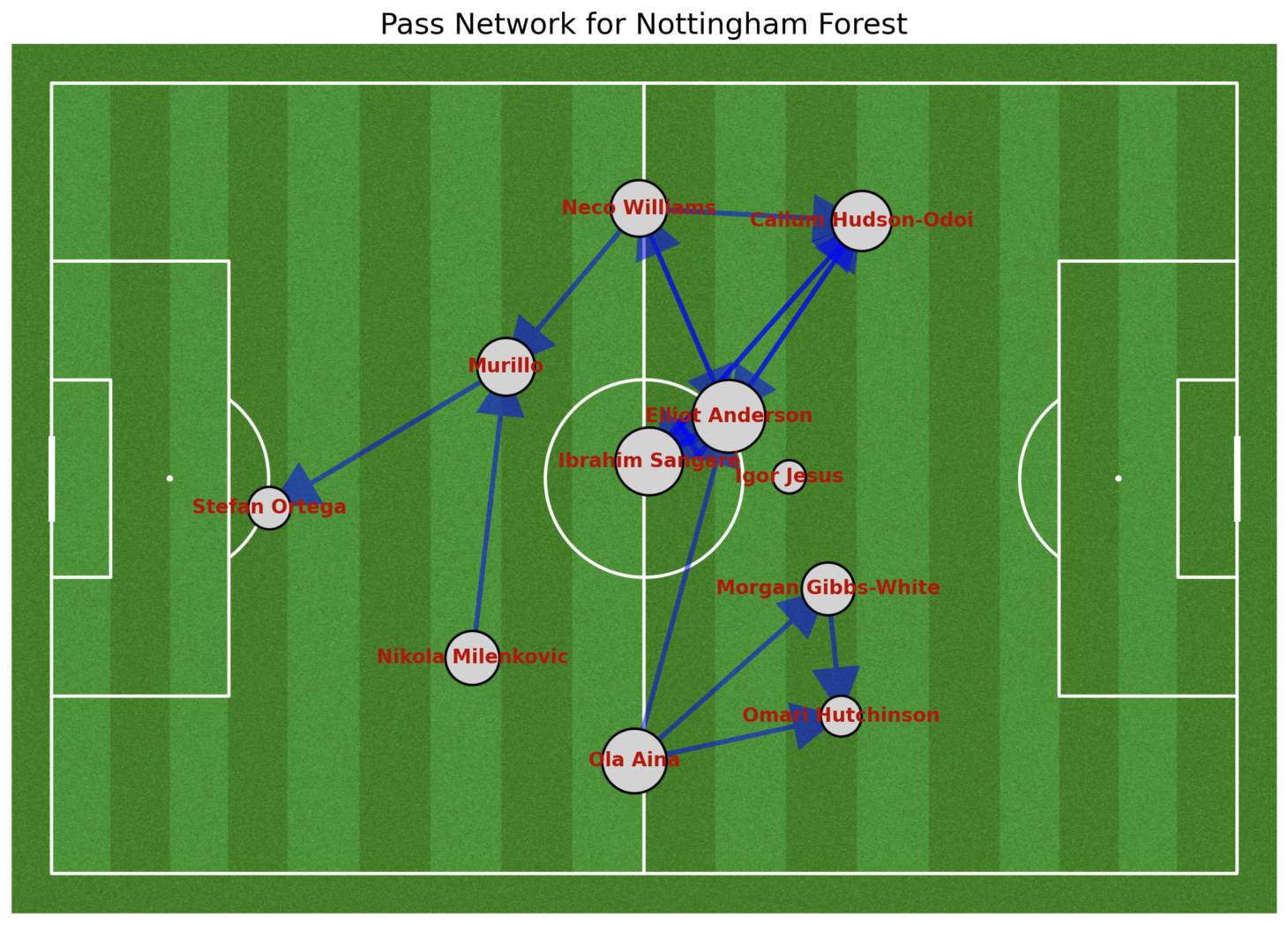
When we look at Forest’s network, a few things stand out immediately.
There’s involvement from the goalkeeper, and the connections often reach out wide early — suggesting Forest prioritized outlets on the flanks before threading balls centrally. The midfield — anchored around Elliot Anderson and Ibrahim Sangaré — is active, but there’s a noticeable distance between the defensive line and the wider attackers.
This results in a shape that feels spread out rather than compressed, with higher vertical distances between units. In simple terms: Forest weren’t squeezing the ball through tight central corridors early on.
Wide players like Hudson-Odoi and Morgan Gibbs-White are positioned higher and slightly out towards the touchline, giving them space to work, but also reducing the potential for intricate short combinations through the spine.
Liverpool’s First-Half Network
 Pass Network for Liverpool
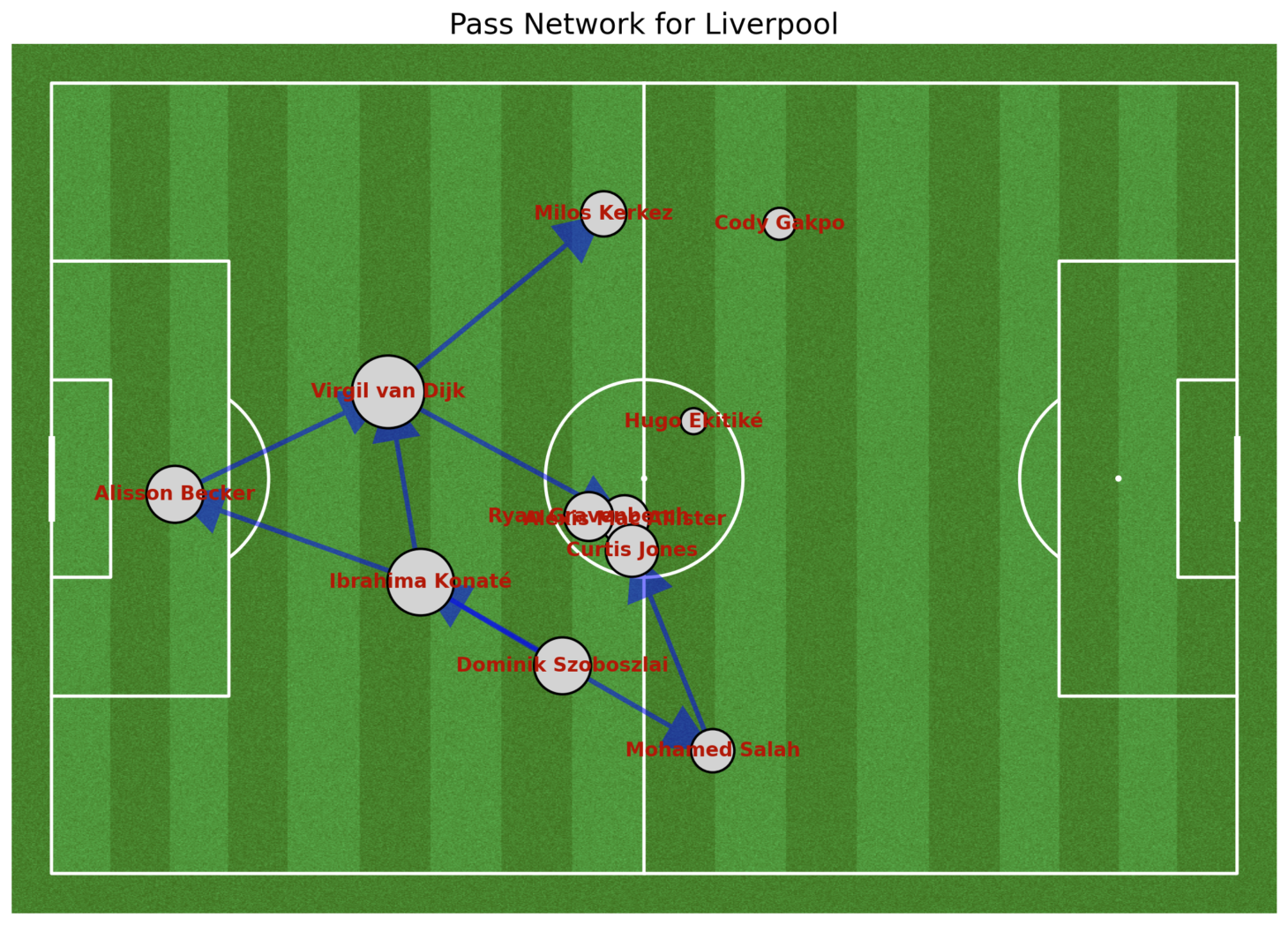
Liverpool’s shape offers a clear contrast.
At the base, Virgil van Dijk is the linchpin — a stable outlet from which the rest of the team circulates. Around him, the midfield cluster (with players like Szoboszlai, Jones, and Mac Allister) creates a tighter central triangle. From there, the ball often progresses toward Salah on the right, who occupies a slightly advanced but connected position.
This structure feels layered — there’s a base, a middle, and an attack that are closer in proximity and linked by short chains of passes rather than isolated vertical kicks. Even when Liverpool switch wide, it feels like a coordinated shift of people and ball rather than a spontaneous bypass of midfield.
What Does This Tell Us About Each Team?
Nottingham Forest
Forest’s first-half pattern suggests a team that was confident to explore width — but wasn’t necessarily built for sustained central control in tight spaces. The spacing between players could make it harder to string together quick progressive combinations, especially against a pressing opponent.
They asked questions early through wide progression and recycling from the keeper, but their network doesn’t scream compression or internal density. Instead, it looks more like a team trying to stretch the game laterally.
Liverpool
Liverpool’s shape, by contrast, reflects a side that likes to structure progression through controlled lanes.
Their central compactness — especially around the double pivot — helped them maintain possession with intent. Rather than reacting to pressure, they created their own pressure by keeping play interconnected. The presence of Salah as both an outlet and a receiver of build-up passes adds a layer of vertical threat that Forest’s wider shape could struggle to contain.
This is not just possession for its own sake. This is intentional control — building from the back, finding lanes through midfield, and retaining structural stability even when pushing forward.
In Short: Contrasting Philosophies
Here’s how we can describe what we saw early on:
- Forest: a wide, stretched shape that sought outlet passes early and relied heavily on wide players and keeper involvement to circulate possession.
- Liverpool: a compact, layered structure emphasizing short combinations, central compression, and controlled progression toward the final third.
Both approaches are valid — but in this match, Liverpool’s compact structure helped them create and sustain territorial advantage more consistently.
As the game unfolded, that structural control translated not just into possession, but into moments of real attacking threat.